

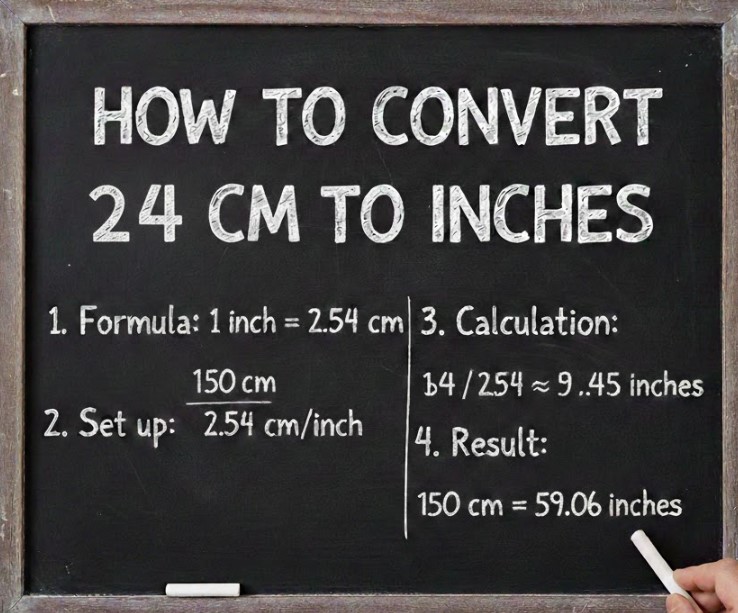
Converting measurements between metric and imperial systems is essential in today’s globalized world. Whether you are measuring furniture, clothing, or scientific data, knowing how to convert 24 cm to inches accurately can save time and prevent errors. While centimeters are widely used in most countries, inches are still standard in the United States and a few other regions. This guide will walk you through the conversion process, provide related conversions, and offer practical tips to ensure precision.
By the end of this article, you’ll not only know how to convert 24 cm to inches but also how to handle related conversions like 23.8 cm to inches, 20.8 cm to inches, 24.1 cm to inches, and even height conversions such as 181 cm to feet inches.
Also Read: How to Get Rid of Gnats: Effective Solutions for Your Home and Plants
Understanding the Basics of Centimeters and Inches
What is a Centimeter?
A centimeter (cm) is a metric unit of length. It is one-hundredth of a meter (1 cm = 0.01 m). Centimeters are widely used in everyday measurements, from the dimensions of a book to the length of a table. For example, a standard pencil is usually about 19 cm long.
What is an Inch?
An inch (in) is part of the Imperial system, primarily used in the United States, Canada, and the UK. One inch equals 2.54 cm exactly, a standard established internationally. Inches are commonly used to measure screen sizes, heights, and furniture dimensions.
Why Conversion Between CM and Inches is Important
Conversions are essential when:
- Buying clothes online from international stores.
- Converting scientific measurements for experiments.
- Measuring furniture or materials in construction projects.
- Understanding height in feet and inches from metric measurements.
For instance, if a table is 24 cm high, knowing it equals 9.45 inches ensures it fits your space correctly.
Step-by-Step Guide – How to Convert 24 cm to Inches
The Formula for Conversion
The most accurate formula for converting centimeters to inches is:inches=centimeters×0.393701
For 24 cm:24×0.393701=9.4488 inches
Rounded to two decimal places:24 cm ≈9.45 inches
This method ensures accuracy for both professional and everyday use.
Using Online Converters and Tools
Online tools simplify conversions. Websites like Metric-Conversions.org or apps like Google Calculator allow instant cm-to-inch calculations. These tools are handy for quick measurements, especially when handling multiple conversions.
Internal Link Suggestion: Link to your site’s metric-to-imperial converter page.
Manual Conversion Tips
For rough estimates, you can use the approximation:1 cm ≈0.4 inches
So, 24 cm ≈ 24 × 0.4 = 9.6 inches (slightly higher than exact). This shortcut is helpful in everyday situations but should not be used for precision tasks.
Also Read: How to Fix a Running Toilet – Step-by-Step Guide and Troubleshooting
Related Conversions You Should Know
Knowing similar conversions helps in real-life scenarios.
Converting Other Centimeter Values to Inches
- 23.8 cm to inches → 23.8 × 0.393701 = 9.37 inches. Useful for measuring small objects like books or screens.
- 20.8 cm to inches → 20.8 × 0.393701 = 8.19 inches. Common in stationery items.
- 24.1 cm to inches → 24.1 × 0.393701 = 9.49 inches. Handy for slight height differences in furniture.
Converting Inches Back to Centimeters
- 2.1 inches to cm → 2.1 × 2.54 = 5.33 cm
- 2.36 inches to cm → 2.36 × 2.54 = 5.99 cm
- 2.6 inches to cm → 2.6 × 2.54 = 6.604 cm
- 22.8 inches to cm → 22.8 × 2.54 = 57.91 cm
- 24.4 inches to cm → 24.4 × 2.54 = 61.98 cm
- 24.5 inch to cm → 24.5 × 2.54 = 62.23 cm
- 24.8 inches to cm → 24.8 × 2.54 = 62.99 cm
These calculations are crucial when comparing international measurements or converting product specifications.
Also Read: How to Clean Retainers: Simple Methods for Daily Care
Converting Heights in Centimeters to Feet and Inches
Many people need to convert height from centimeters to feet and inches:
- 181 cm to feet inches → 5 ft 11 in (181 ÷ 2.54 = 71.26 inches → 5 ft 11.26 in)
- 182.88 cm to inches → 182.88 × 0.393701 = 72 inches → exactly 6 ft
- 186 cm to feet and inches → 6 ft 1 in
- 189 cm to inch → 189 × 0.393701 = 74.41 inches
- 190.5 cm to inches → 190.5 × 0.393701 = 75 inches → 6 ft 3 in
- 193 cm to feet and inches → 193 × 0.393701 = 75.98 inches → 6 ft 3.98 in (~6 ft 4 in)
- 255 cm to inches → 255 × 0.393701 = 100.39 inches → 8 ft 4 in
These conversions are particularly helpful for sports stats, architecture, and designing custom furniture.
Tips for Accurate Measurement and Conversion
- Always Use Precise Formulas:
Avoid relying solely on approximations, especially in construction or science. - Rounding Considerations:
Decide whether to round to one decimal, two decimals, or whole numbers based on your application. - Tools to Measure Accurately:
- Rulers and tape measures for everyday use.
- Calipers for precision in small objects.
- Laser distance meters for large-scale measurements.
- Consistency:
Always stick to either metric or imperial units throughout your project to avoid confusion.
Also Read: How to Cut a Pomegranate: Step-by-Step Guide for Perfect Results
FAQs
Q1: How do I quickly convert cm to inches without a calculator?
A1: Use the approximation 1 cm ≈ 0.3937 inches or roughly 0.4 inches for quick estimates.
Q2: Why is my conversion slightly different when rounding?
A2: Rounding errors occur when you limit decimal places. For precise work, keep at least four decimals.
Q3: Are there apps that can convert cm to inches instantly?
A3: Yes, Google Calculator, Metric Conversions app, and many online tools allow instant conversion.
Q4: What is the difference between standard inches and metric approximations?
A4: One inch is always 2.54 cm exactly. Approximations like 0.4 cm per inch are for mental calculations only.
Conclusion
Converting 24 cm to inches is simple once you understand the formula and the context. Using the formula:inches=cm×0.393701
We found that 24 cm ≈ 9.45 inches.
Knowing related conversions like 23.8 cm to inches, 20.8 cm to inches, or converting height measurements such as 181 cm to feet inches can be extremely useful in daily life, professional projects, and scientific tasks. Accurate conversions help ensure consistency, precision, and proper understanding across different measurement systems.
For More Visit Little D Brewfest
