

Introduction
In medical devices, aerospace, and high-end industrial automation, minuscule tolerance deviations in components can directly lead to assembly failure, performance degradation, and even safety hazards. Many manufacturers pursuing ultra-high precision at the ±0.01mm level often face fluctuating yield rates and skyrocketing costs.This dilemma typically stems from a lack of systematic understanding of precision manufacturing, focusing solely on the machine tool itself while neglecting comprehensive factors such as material stability, thermal deformation control, toolpath optimization, and real-time quality feedback.
This article will systematically deconstruct the complete technical scheme for achieving and stably maintaining ±0.01mm tolerances, covering the entire process’s key control points from material science fundamentals to advanced in-process compensation technologies.
Why are Material Properties and Heat Treatment the First Line of Defense for Tolerance Control?
In the pursuit of ultra-tight tolerances like ±0.01mm, the inherent “nature” of the material is the primary determinant. Even with the most advanced machine tools, neglecting internal residual stresses, anisotropy, and work-hardening characteristics can lead to spontaneous deformation of the workpiece during or after machining,could render precise dimensions meaningless. For instance, stainless steel is prone to developing localized stress due to high cutting temperatures, while some aluminum alloys, being softer, are more susceptible to elastic deformation under clamping and cutting forces.
The Foundation of Precision: Materials Science
Achieving ultra-high precision with Precision Manufacturing Solutions begins with a deep understanding of materials. Materials are not isotropic; their internal grain direction and lattice structure cause differential dimensional springback when machined in different orientations. Therefore, selecting the most suitable base material based on the part’s stress loads and accuracy requirements is the starting point for success. This fundamental principle applies to all CNC machining parts, where material choice dictates the achievable stability.
Heat Treatment: The Key Process for Releasing Internal Stresses
To tame a material’s internal stresses, advanced heat treatment processes like pre-conditioning and cryogenic treatment are indispensable. These processes can actively and uniformly release or redistribute internal stresses before or after the rough machining of CNC machining parts, providing a dimensionally stable “blank” for subsequent finishing. Research from the Society of Manufacturing Engineers (SME) clearly indicates that scientific material pretreatment can improve final machining accuracy by over 30%.
The DFM Practice of a Professional Manufacturer
A professional manufacturer integrates materials science deeply into Design for Manufacturability (DFM) analysis. This goes beyond simple material substitution; it is a systematic recommendation based on part geometry, function, and tolerance requirements.
- Tailored Material Selection
For example, when providing stainless steel CNC machining services, experts recommend specific grades like 304, 316, or 17-4PH based on the part’s structural complexity.
- Process Integration
They plan corresponding solution, aging, or stress-relief annealing processes to lock in dimensional stability from the source. You can obtain a detailed material and pre-treatment analysis for your project through a specialized provider like stainless steel CNC machining services.
How Do Multi-Axis CNC Strategies Overcome the Precision Bottleneck of Complex Geometries?
For parts with complex surfaces or deep cavities, such as impellers or medical implants, traditional 3-axis machining often requires multiple setups. Each re-positioning and re-clamping introduces new errors, and the cumulative effect seriously threatens the achievement of final tolerances. The core advantage of 5-axis simultaneous machining technology lies in completing most or all features in a single setup,The problems of reference loss and error superposition caused by repeated clamping are completely eliminated.
Advanced CNC Machining strategies come into play here. For instance, trochoidal milling, applied in 5-axis CNC machining, significantly reduces cutting force per tooth and heat buildup by allowing the tool to take continuous, light cuts along a cycloidal path. This is crucial for controlling distortion in thin-walled, low-rigidity parts. Point milling (point-contact milling) is particularly suitable for cleaning corners in complex cavities and achieving high-quality surface finishes, effectively reducing tool wear and maintaining machining consistency. The parameter optimization for these strategies is not based on intuition but follows strict dynamic principles, as outlined in guidelines from the Association of German Engineers (VDI).
Consider the case of a complex titanium alloy bracket for aerospace. By employing a 5-axis simultaneous strategy combined with high-speed milling and trochoidal milling, not only were all spatially angled hole patterns and surfaces completed in one setup, but the geometric tolerances of critical areas were also consistently controlled within ±0.015mm, laying a solid foundation for meeting even more stringent assembly accuracy requirements later. This mastery over complex geometry is the key to breaking through precision bottlenecks when manufacturing custom machined parts.
Is In-Process Inspection and Real-Time Compensation the Ultimate Answer to the Precision Closed Loop?
The traditional “machine, inspect offline, adjust” model suffers from inherent latency. By the time a Coordinate Measuring Machine (CMM) in another room detects a dimensional deviation, the machine may have already produced several non-conforming parts. To stably achieve micron-level tolerances, inspection must be integrated into the machining cycle, forming a real-time feedback loop.
Real-Time Data Acquisition: The Machine’s “Sensory” System
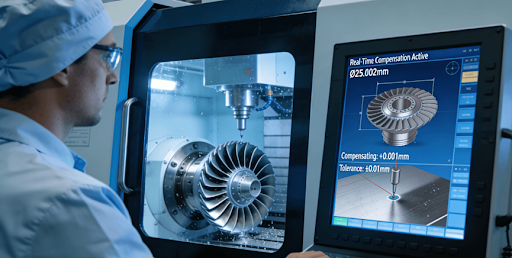
The first step towards a closed loop is the integration of on-machine probes and laser scanners within the machining center. During the process or between operations, the probe automatically touches or scans the workpiece, instantly capturing real-time data of key dimensions with micron-level accuracy. This equips the CNC machine online with sharp eyes.
Intelligent Compensation: The System’s “Decision” and “Execution”
After acquiring data, the machine’s CNC system or a higher-level MES system initiates the core compensation logic. By comparing measured values with the theoretical model, the system automatically calculates errors caused by tool wear, spindle thermal growth, or slight workpiece deformation and immediately makes micro-adjustments to the tool offset or machine coordinate system online. This process is dynamic and continuous, ensuring machining accuracy does not drift over time or with changing conditions.
- The Core Technological Barrier
This is the core technological barrier that allows top-tier tolerance machining services providers to promise and deliver ±0.01mm tolerances.
- From Assurance to Control
The integration of in-process inspection and real-time compensation technology marks a new stage in precision manufacturing, moving from “guaranteeing accuracy after the fact” to “actively controlling accuracy during the process.”
Practical Application and Reference
It forms a self-aware, self-deciding, self-executing precision closed loop,significantly enhances manufacturing determinism and consistency. To gain a deeper understanding of how this technology ensures a complete ±0.01mm tolerance in practice, you can refer to this technical blog post on tolerance machining services.
How Do Professional Surface Treatments Affect the Final Realization of Micron-Level Tolerances?
A common misconception is that part accuracy is fixed after CNC machining. In reality, surface treatments like anodizing or plating irreversibly alter final dimensions. Coating thickness variation and induced stress can render a precise part non-conforming.
Therefore, in professional precision manufacturing, surface treatment is a critical, upfront design consideration. Engineers must incorporate precise “coating allowance” into the tolerance stack. For a ±0.01mm tolerance surface receiving a 30µm coating, the machined dimension must be correspondingly reduced.
This systematic planning, while adding complexity, is essential to prevent batch rejection and control overall cost risk. It epitomizes the full-process control that differentiates high-end manufacturing from ordinary machining.
When Selecting a Supplier, Beyond Accuracy Promises, What Quality Systems Should Be Audited?
When selecting a partner for ultra-high-precision work, auditing their quality systems is as crucial as evaluating their capabilities. The assessment should begin with their metrology foundation, ensuring key equipment is properly calibrated and that Measurement System Analysis validates their inspection data. Rigorous First Article Inspection and Statistical Process Control for critical processes are essential for stability in Industrial Automation Technology.
Furthermore, authoritative international certifications like IATF 16949 (automotive), AS9100D (aerospace), and ISO 13485 (medical) provide the strongest proof of systemic maturity. A custom CNC machining manufacturing provider holding such credentials demonstrates superior process control, traceability, and risk management, building a reliable foundation for online CNC machining services. A manufacturer like JS Precision, with multiple top-tier certifications, exemplifies this level of assured capability.
Conclusion
In today’s globalized supply chains, selecting a partner with systematic precision control capabilities and top-tier international certifications is crucial for ensuring project success and controlling overall risk.
If you are looking for a reliable manufacturing partner for a high-precision project, you are welcome to upload your 3D drawings to obtain instant professional DFM analysis and quotation. Let your design achieve precise realization from millimeters to microns.
FAQs
Q: Does achieving ±0.01mm tolerance significantly increase the CNC machining price?
A: It does increase the cost, primarily due to the use of more advanced machine tools, longer cycle times per part, more frequent in-process inspections, and more stringent quality checks. However, for high-value critical components, the resulting performance improvement and reduced scrap rate often yield significant overall cost-effectiveness.
Q: Which materials are most suitable for achieving such ultra-high precision?
A: Materials with good stability, such as Invar steel, some pre-hardened tool steels, and fully aged aluminum alloys, are preferred. Material homogeneity and heat treatment condition are often more important than the type of material itself.
Q: How do online CNC machining services ensure traceability for this level of precision?
A: Reputable service providers will supply complete documentation for each batch, including a full First Article Inspection Report (FAIR), SPC charts for critical dimensions, and material certifications. This constitutes a traceable quality evidence chain.
Q: For small-batch prototypes, can ±0.01mm tolerance also be achieved?
A: Yes, but the challenge is greater because there are fewer samples for process parameter optimization. This relies more heavily on the supplier’s process database and experience, achieved through simulation and conservative machining strategies.
Q: How significant is the impact of ambient temperature fluctuation on ±0.01mm tolerance?
A: The impact is substantial. Precision workshops must maintain a constant temperature of 20°C ±1°C. For steel parts, a 1°C temperature change per meter of length produces approximately 12µm of deformation. Therefore, environmental control is an essential condition.
